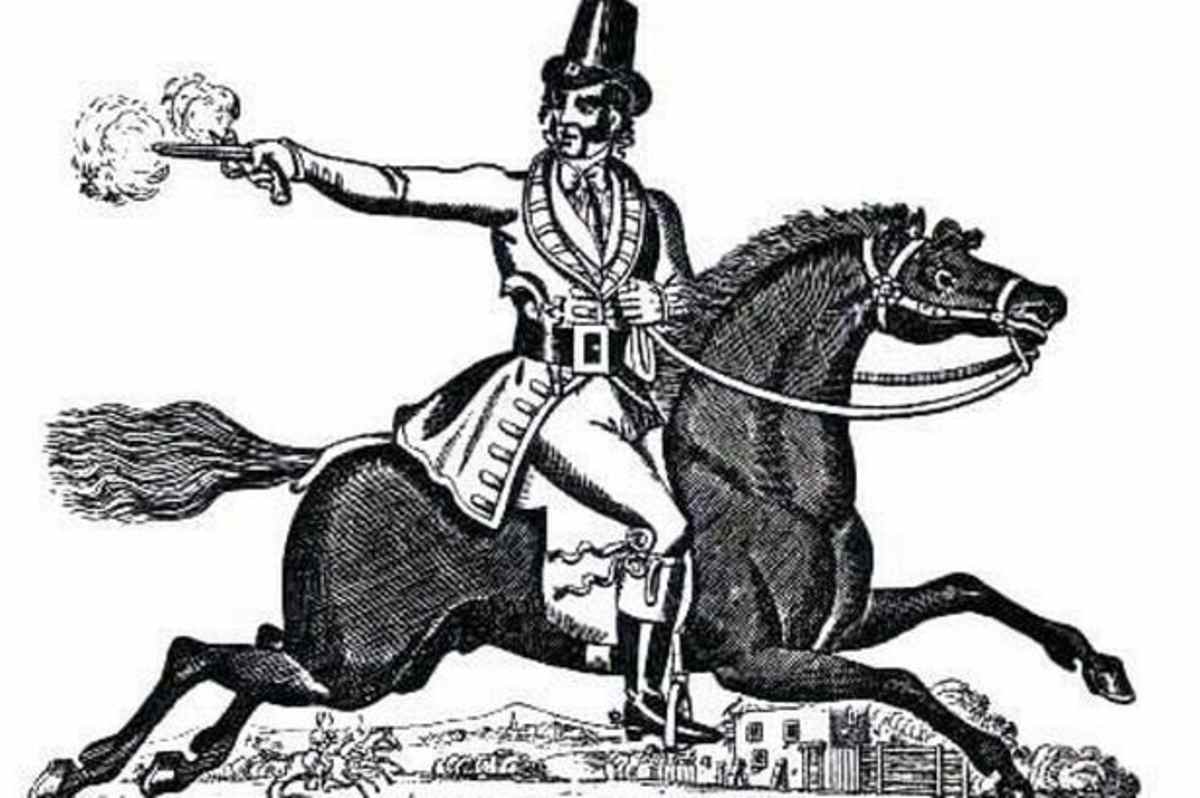
No figure is more closely associated with the romance—and the reality—of the English highwayman than Jerry Abershawe. Although he died in 1795, twenty years before the Battle of Waterloo, his reputation lingered well into the Regency. Long after his execution, travellers passing Putney Vale could still remember the place where his body had hung in chains, and novelists continued to invoke his name as a byword for danger on the road.
Born Louis Jeremiah Abershawe around 1773, Jerry was no gentleman outlaw in the mould of romantic fiction. He led a gang of robbers operating on the busy roads between London and Kingston upon Thames, preying upon wealthy travellers, mail coaches and anyone unfortunate enough to cross his path. His headquarters were said to be the Bald-Faced Stag Inn at Putney Vale, from where he and his associates could watch the traffic heading out of London.
Highway robbery was a profitable business in the eighteenth century. England's roads were poorly policed, wealthy travellers carried cash, jewellery and watches, and there was no organised police force to pursue criminals. Heathland and woodland provided perfect hiding places, while fast horses offered a ready escape. A highwayman's cry of "Stand and deliver!" became one of the most famous phrases in English history.
Abershawe quickly gained a fearsome reputation. Unlike the fictional gentlemen highwaymen who politely relieved ladies of their jewels with a bow, or the historical Claude Duval, he was known to be violent. His downfall came in January 1795 when he shot and killed a constable attempting to arrest him. After months on the run, he was captured in a Southwark public house and brought to trial.
Contemporary accounts describe an astonishing lack of fear. He reportedly smiled at the judge while sentence was pronounced, sketched scenes from his own exploits on his prison walls, and chatted cheerfully on the cart ride to the gallows. On 3 August 1795 he was hanged at Kennington Common.
His punishment did not end there. His body was suspended in irons beside the Portsmouth Road at Putney Vale as a grim warning to other criminals. The gibbet remained a landmark for years afterwards, and Abershawe became the last highwayman in England whose body was publicly displayed in this way.
By the Regency era, highwaymen themselves were becoming rare. Better roads, mounted patrols, and improved policing made their profession increasingly difficult. Yet the legend endured. Readers thrilled to tales of masked riders, moonlit escapes and desperate pursuits across lonely heaths, even though the real men were often brutal criminals rather than gallant rogues. You've heard of Dick Turpin? Definitely not the least bit romantic!
And yet, highwaymen continue to fascinate us. History remembers the violence; fiction remembers the romance. Somewhere between the two rides Jerry Abershawe—a man feared in his own lifetime, yet transformed by time into one of the enduring legends of the English road. In my latest Regency romantic adventure, LYON ON THE LOOSE, I feature what appears to be a highway robbery. It gives Roland Chetwynd the opportunity to play the hero, but at a greater cost than he ever expected...