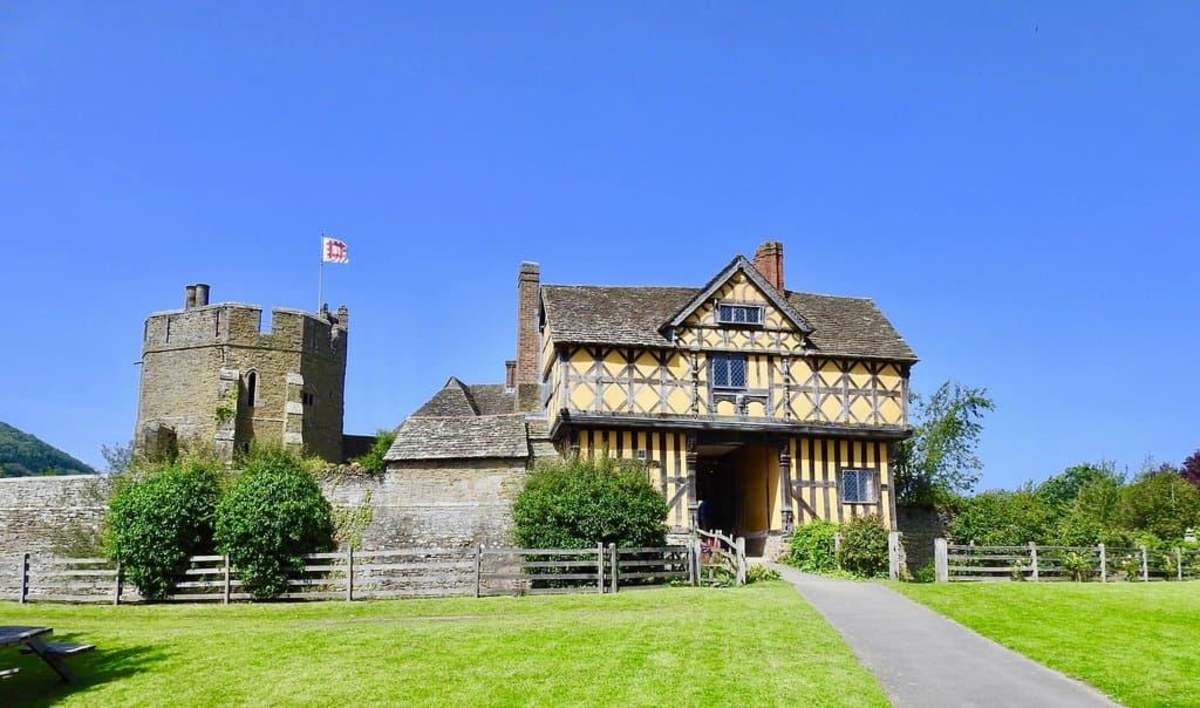
One of the inspirations behind Mundlingham Castle in Lyon on the Loose was Stokesay Castle in Shropshire: not quite a castle in the military sense, but something perhaps even more intriguing—a fortified medieval house.
Set in a peaceful valley near the Welsh border, Stokesay is one of the best-preserved fortified manor houses in England. Most of what visitors see today was built in the late thirteenth century by Laurence of Ludlow, a wealthy wool merchant who bought the manor in 1281. His fortune came not from conquest or ancient noble blood, but from trade—particularly the immensely profitable medieval wool business. That makes Stokesay especially fascinating. It was not simply a fortress; it was a statement.
At first glance, Stokesay has all the romance of a castle: a moat, towers, a great hall, stone walls and a gatehouse. Yet its defences were more about appearance and prestige than serious warfare. Despite being built like a castle, it was really a lightly defended mansion, and that distinction is part of its charm. It suggests a world in which status, security and display were deeply entwined. Laurence of Ludlow wanted a grand, safe, impressive home—one that announced his wealth and importance without necessarily having to withstand a siege.
The great hall remains one of Stokesay’s most atmospheric features. It is easy to imagine feasting, bargaining, gossip and domestic ceremony taking place beneath its timber roof. The north and south towers added both grandeur and reassurance, while the later timber-framed gatehouse, built in 1640–41, gives the approach an almost storybook quality. That mixture of medieval solidity and later picturesque detail makes Stokesay feel like a place layered with time. When I visited several years ago, the place was full of swallows, swooping through empty window frames to feed their babies, a sight which pleased me as much as the place itself.
Over the centuries, Stokesay passed through different hands, including the Vernon and Craven families. During the Civil War, its Royalist connections brought trouble, though the house escaped the kind of destruction suffered by many castles. Later, like so many old buildings, it was partially neglected before being repaired, preserved and eventually placed in the care of English Heritage.
For a novelist, Stokesay offers more than architectural beauty. It represents the perfect in-between place: neither a grim fortress nor a delicate country house, but something older, stronger and stranger. A fortified house carries different imaginative possibilities from a grand ducal mansion. Its walls suggest protection, but also secrets. Its towers promise romance, but also isolation. Its domestic spaces remind us that power is not always expressed on a battlefield; sometimes it is displayed in a hall, a gateway, a family legend or a locked room.
Mundlingham Castle in Lyon on the Loose is not Stokesay, but Stokesay helped me imagine the kind of place Mundlingham might be: ancient, atmospheric, slightly impractical, and full of echoes. A house like that does not merely provide a setting. It becomes part of the story.