Direct experience of Tudor Life!
It really helped that I had been a historical re-enactor at Kentwell Hall before I wrote my Tudor TRYSTS AND TREACHERY series. I thought it would be fun to share with you some of the items I needed to recreate an authentic Tudor experience.
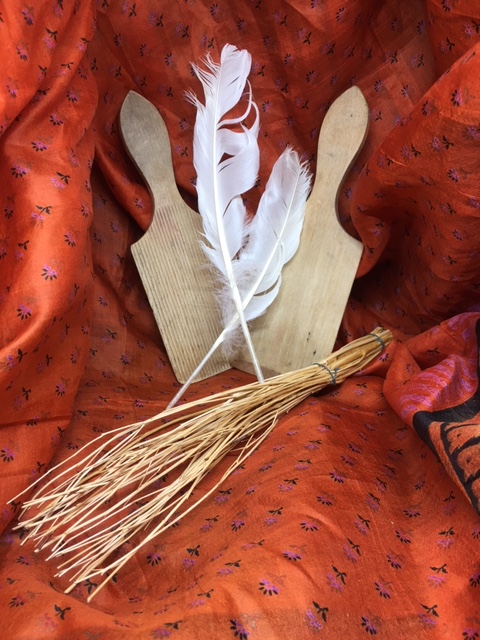
This photo shows what we called “butter hands”. Nowadays, they are called “butter pats” and are literally used to pat the liquid whey out of the butter as it is being shaped. I used the whisk, made from bendy hazel twigs, to whisk up the cream for making butter.
The goose feathers were used when I made sugared rose petals. You have to paint the egg white onto the petals to make the sugar stick. The petal then hardens and can be used as an edible decoration on Tudor desserts.
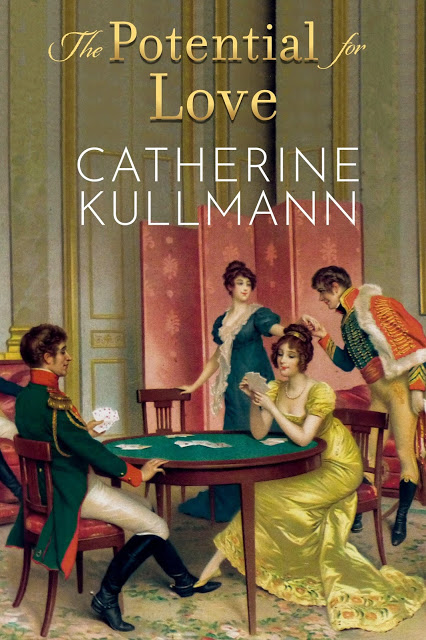
I am proud to present to you Catherine Kullmann’s latest Regency novel, “The Potential for Love”!
I’m thrilled to be able to host this post as part of the Coffee Pot Book Club Blog Tour. Read on to find out about the book, the author and the fascinating historical background against which the story is set.
Here’s the story-
1816
For over six years, Thomas Ferraunt’s thoughts have been of war. Newly returned to England from occupied Paris, he must ask himself what his place is in this new world and what he wants from it. More and more, his thoughts turn to Arabella Malvin, but would Lord Malvin agree to such a mismatch for his daughter, especially when she is being courted by Lord Henry Danlow?
About to embark on her fourth Season, Arabella is tired of the life of a debutante, waiting in the wings for her real life to begin. She is ready to marry. But which of her suitors has the potential for love and who will agree to the type of marriage she wants?
As she struggles to make her choice, she is faced with danger from an unexpected quarter while Thomas is stunned by a new challenge. Will these events bring them together or drive them apart?
We are celebrating the release of the special hardback edition of The Potential for Love during this tour. With a beautiful dust jacket over an elegant laminated cover, it will enhance any library and is the perfect gift for lovers of historical women’s fiction and historical romance.
The book is available as an ebook, a paperback or a hardback, from the following retailers-
The Historical Backdrop to The Potential for Love
By Catherine Kullmann
The first quarter of the nineteenth century was one of the most significant periods of European and American history whose events still resonate after two hundred years. The Act of Union between Great Britain and Ireland of 1800, the Anglo-American war of 1812 and the final defeat of Napoleon at the Battle of Waterloo in 1815 all still shape our modern world. But the aristocracy-led society that drove these events was already under attack from those who saw the need for social and political reform, while the industrial revolution saw the beginning of the transfer of wealth and ultimately power to those who knew how to exploit the new technologies.
Strictly speaking, the Regency refers to the period from February 1811 when the then Prince of Wales became Prince Regent due to the mental incapacity of his father, King George III until the King’s death January 1820 when the Prince succeeded him as George IV. But long before he became Regent, the Prince’s extravagant lifestyle and love of pleasure and the arts had begun to shape British society, a society that had already been shaken by two revolutions. The first resulted in the loss of the American colonies while the second led the royalty and aristocracy of France to the guillotine. In 1781, British forces marched out of Yorktown to the tune of The World Turned Upside Down and in the succeeding decades, it must have seemed to the British that nothing was the same again. And if nothing is the same, why not try something new?
Like the sixties of the twentieth century, the Regency was a period of great change made immediately visible by a revolution in fashion. Wide hooped skirts gave way first to less voluminous gowns and then to skimpy white muslin dresses that looked almost like shifts or petticoats. Elaborate hairstyles were abandoned in favour of short curls or classical, Grecian styles. Men abandoned their ornate silk and satins in peacock colours for garments based on a country-gentleman’s riding clothes.
In literature, the romantic poets reigned, at their head Wordsworth and Coleridge, not to mention the notorious Lord Byron who said after the publication of Childe Harold in 1812 ‘I awoke one morning to find myself famous’ and who, after their first meeting, was described by his later lover Lady Caroline Lamb as ‘mad, bad and dangerous to know’, although this was certainly a case of the pot calling the kettle black Unable to compete with Byron, Walter Scott turned to writing novels and Jane Austen’s six novels, all published during the Regency, enthralled discerning readers.
Country dances gave way to quadrilles and, scandalously to the waltz where, instead of making up sets of dancers, a couple could revolve in close proximity to each other unhindered by the other dancers in a set (think of the difference between square-dancing and jive). The lyrics of Thomas Moore introduced traditional Irish melodies to the wider world. Architecture moved from neo-classicism to neo-gothic, via a few exotic detours such as the Egyptian style – crocodile-footed furniture anybody?—and the exotic orientalism of the Regent’s Pavilion at Brighton.
But the Regency had its dark side too. It was a very unequal society. At the top of the pyramid sat royalty, the nobility and gentry i.e. those wealthy enough to maintain their families, including servants from unearned income. These households amounted to just over 5% of the population. The small, glittering world of the haut ton was made possible by the labour of the poorly paid lower classes. Fortunes were won and lost gambling and the gentleman’s code of honour required him to pay his gambling debts, even if this meant that tradespeople and other creditors went unpaid.
A series of enclosure acts reduced the rights of the peasants and reinforced the dominance of the land-owners. The Corn Laws, by imposing restrictions and tariffs on imported grain, also benefited the landowners but kept the price of bread artificially high. Poor harvests and a downturn in the economy after the end of the Napoleonic Wars, together with increasing resentment at the lack of parliamentary representation led to unrest and public protest, There was constant unrest in Ireland where the Catholic majority were barred from sitting in either house of Parliament and forced to pay tithes to an alien church.
The Potential for Love is set in 1816, starting almost nine months after the Battle of Waterloo in June 1815 put a final end to twelve years of war with France. Napoleon has been defeated for the second time and exiled to the tiny Atlantic island of St Helena. The United Kingdom must now count the cost of the long war, both human and financial. Some families mourn their loved ones while others welcome sons, fathers, brothers who have spent years away from home.
It is very much a patriarchal world where women, especially married women, have few or no rights but they have begun to raise their voices, demanding equality and emancipation, even happiness.
©Catherine Kullmann 2020

All about Catherine Kullmann
I was born and brought up in Dublin and moved to Germany on my marriage in 1973. Before my marriage, I was an administrative officer at the Department of Finance in Dublin. I worked as attaché at the Irish Embassy in Bonn until my eldest son was born. Following a twelve-year stint as a full-time mother, I joined the New Zealand Embassy in Bonn, where I was administration officer. My husband and I returned to Ireland in 1999 and in 2009, following a year’s treatment for breast cancer, I took early retirement from my position as Director of Administration and Human Resources at a large Dublin law firm.
I have always enjoyed writing, I love the fall of words, the shaping of an expressive phrase, the satisfaction when a sentence conveys my meaning exactly. I enjoy plotting and revel in the challenge of evoking a historic era for characters who behave authentically in their period while making their actions and decisions plausible and sympathetic to a modern reader. In addition, I am fanatical about language, especially using the right language as it would have been used during the period about which I am writing. But rewarding as all this craft is, there is nothing to match the moment when a book takes flight, when your characters suddenly determine the route of their journey.
The first quarter of the nineteenth century was one of the most significant periods of European and American history, a period whose events still resonate two hundred years later The Act of Union between Great Britain and Ireland of 1800, the Anglo-American war of 1812 and the final defeat of Napoleon at the Battle of Waterloo in 1815 all still shape our modern world. The aristocracy-led society that drove these events was already under attack from those who saw the need for social and political reform, while the industrial revolution saw the beginning of the transfer of wealth and ultimately power to those who knew how to exploit the new technologies.
I write historical fiction set against this background of off-stage wars, of women frequently left to fend for themselves in a patriarchal world where they have few or no rights but must make the best lives they can for themselves and their families. While real people sometimes have walk-on parts, the protagonists and their stories are pure fiction. As well as meeting their personal challenges, they must also cope with external events and the constraints imposed by society. The main story arc is romantic. I am particularly interested in what happens after the first happy end—how life goes on around the protagonists and sometimes catches up with them.
Social Media Links:
Website • Twitter • Goodreads.
A hero with amnesia and an indefatigable heroine
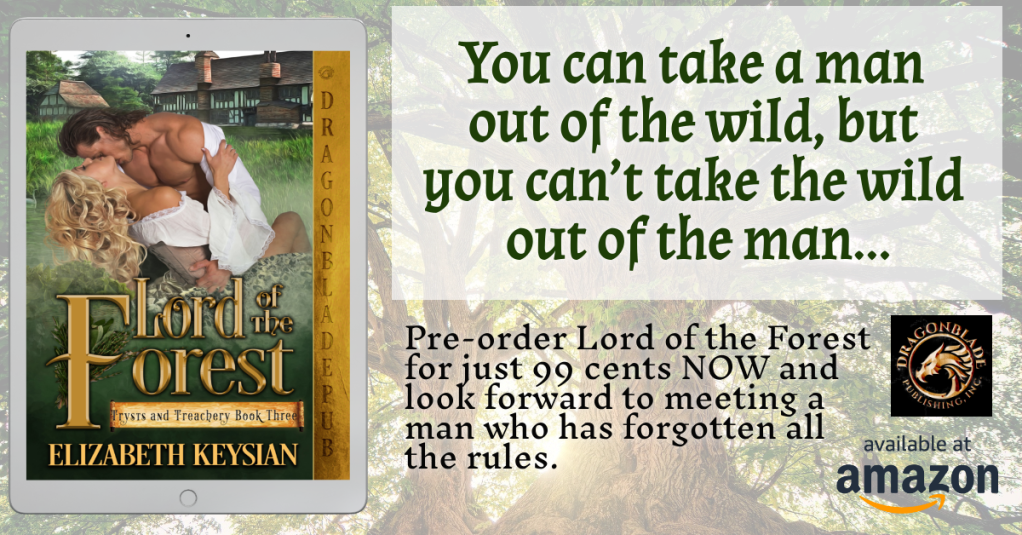
I thoroughly enjoyed writing the story of the romance between the two main characters in LORD OF THE FOREST, Book 3 in the Trysts and Treachery series. I thought I might experiment by putting a few excerpts and extracts out there.
Here’s the main drive of the story-
You can take a man out of the wild, but you can’t take the wild out of the man.
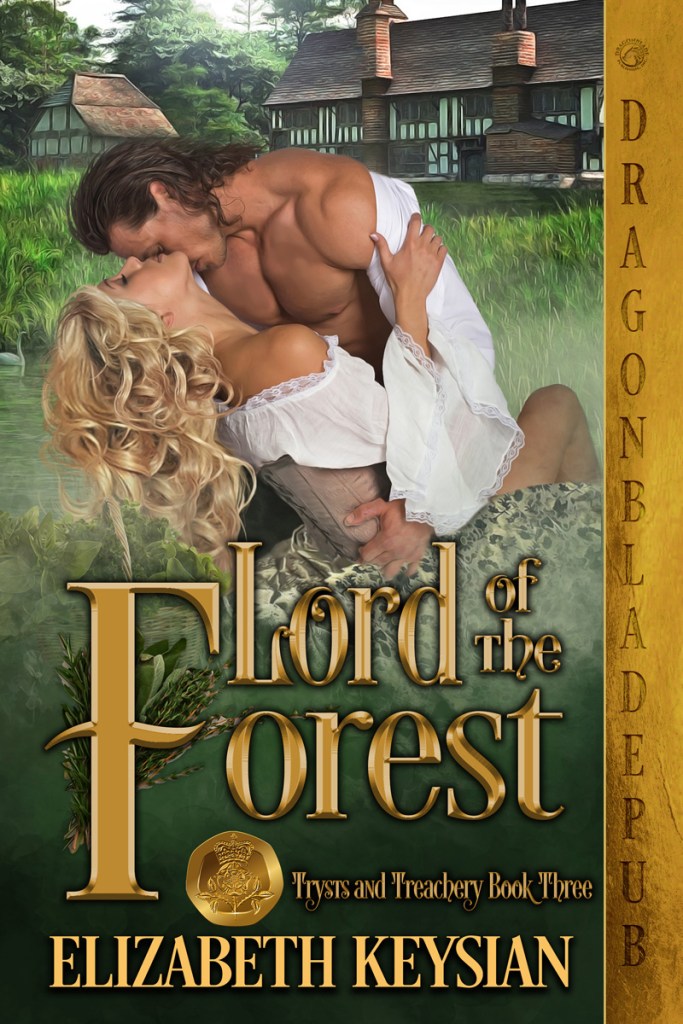
She failed to save the man she loved. She won’t make the same mistake again.
Desperate to avoid a suffocating marriage, Clemence plans to dazzle at court, and remain as chaste as The Virgin Queen. Then she’s rescued from kidnappers by the mysterious Lancelot, and only a betrothal to him can save her reputation. But what could induce her father to give her to a man with no memory, no status, and no home but the forest? Especially when that man has a propensity for throwing people into horse troughs, getting himself poisoned, and being accused of murder.
In his forest home, he’s a king among both beasts and men.
Lancelot does everything differently. He can’t help it; he’s been living free in the forest with no memory of shame, sin or the reason for wearing clothes. No memory of anything at all, in fact, although his dreams reveal he’s had a close brush with death. But was he a victim or quite the opposite?
Living hand-to-mouth in his woodland lair, Lancelot is used to helping himself to what he wants, and he wants Clemence. But when she drags him back into the real world, he soon realizes that she will bring him either salvation… or oblivion.
Here’s the excerpt. If you’re wondering about the sword, the setting is England in 1585. Our hero has just been taken back to his home, though he has no memory of the place. The heroine is trying to restore his memory, despite him being concerned about what dark secrets might be unearthed…
“He tried the weight of the sword, then swung it around in an arc. His arm seemed to move of its own accord, blocking imaginary blows to his shoulders and legs.
“Some of my knowledge has been restored by reading your father’s books. Some things I simply remember—or at least the knowledge comes back if I worry at it like a terrier at a rat. And sometimes, skills return to me—like this.” He swung the sword again, stabbing it with pinpoint accuracy at the center of a red poppy on the tapestry. “Hopefully, more abilities will return if I have need of them.”
“You have scars on your back. Someone attacked you with a sword or a knife, and evidently bested you.”
A fact he had to face, though he hated it. “Mayhap I had no weapon with which to defend myself. Or was already incapacitated.”
She grimaced. “Then it was a cowardly attack. Mayhap I should have a sword, too, in case I need to defend myself.”
He immediately sheathed the ancient weapon he’d found, and fastened the belt around his hips. “Not while I draw breath, you won’t. If you hold a blade, your attacker will feel forced to use his own. If you have no weapon, he’ll be more inclined to parley. Besides, what need have you of steel when you have me to protect you?”
She tossed her head. “I suppose you’ll tell me next that swordplay isn’t so much fun as it looks. And I thought you a free spirit, with a mind open to new ideas, eschewing the everyday rules by which we live.”
He’d thought himself a free spirit, too, by comparison. But when it came to Clemence, he found he could happily follow the rules if it kept her safe.
“When I know what I know and how I know it, I might then be in a position to teach you, oh, courageous maid. But for now, I am the one wearing the sword, and intend to keep it that way.”
If you want to pre-order the book, you can do so here-
http://mybook.to/lordoftheforest
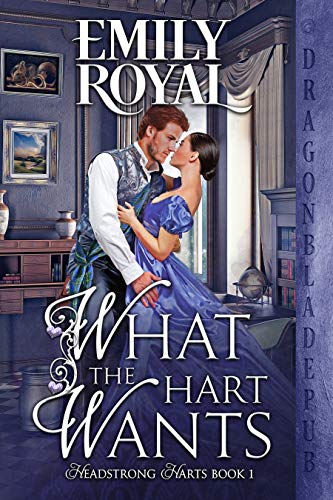
The latest sumptuous offering from Dragonblade author, Emily Royal
What the Hart Wants by Emily Royal
My rating: 5 of 5 stars
Woohoo! Another fabulous offering from the pen of Emily Royal. I love a strong, determined hero who gets stopped in his tracks by a feisty heroine. Even better if that hero is a muscular Scot who makes one weak at the knees!
Despite her prejudices, the heroine, Delilah, is persuaded to overcome her inherent dislike of the aristocracy. Well, who wouldn’t, with the delicious Fraser MacGregor to spar with? And there are plenty of other intriguing characters adding colour to the story—I can’t wait to meet them again in future stories. Ahhh- Fraser MacGregor. Not just a Scot, but a duke too- my dreams will be sweet tonight!
This book will be out tomorrow- grab your copy HERE.
View all my reviews
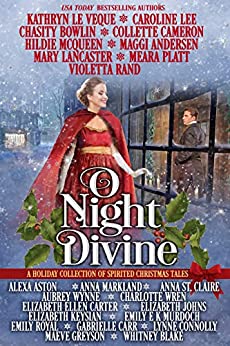
An amazing seasonal boxed set from Dragonblade!
I know it’s a bit early for Christmas, but when you can pre-order a collection of over TWENTY brilliant stories from Dragonblade authors for just 99 cents, the sooner you do so, the better! Grab your copy of O NIGHT DIVINE and give yourself something to look forward to.
A MASTERPIECE OF HOLIDAY STORYTELLING…
Enjoy this stunning holiday collection from some of your favorite Dragonblade Publishing authors in this collection of never-before published seasonal tales!
Imagine, if you will, that it is Christmas Eve.
The candles are guttered, one by one, and a hush falls over the parlor. The children have gone to bed, and a tall, gloriously decorated Christmas tree looms in the shadows of the hearth’s dying embers. A tattered copy of Charles Dickens’ masterwork, “A Christmas Carol” sits, cold and lonely, upon a table nearby.
A small gust of wind, hurling from the seam of an ill-fitting window, blows the cover open. The first chapter appears… “Marley’s Ghost”…
The clock on the wall chimes midnight.
Now, the magic happens.
From the gaily bedecked halls of Regency England to the cold and crisp air of the Scottish Highlands, and everything in between, enjoy the magic of a holiday collection that has drawn inspiration from Charles Dickens’ most beloved literary works. Where the ghosts of Christmas, the incandescent spirit of a tiny disabled boy, and the joy that is the very heart of the Christmas season come alive.
USA Today and Internationally bestselling authors bring you their version of a Dickens’-inspired holiday in O NIGHT DIVINE.
This collection includes:
Kathryn Le Veque
Caroline Lee
Chasity Bowlin
Collette Cameron
Hildie McQueen
Maggi Andersen
Mary Lancaster
Meara Platt
Violetta Rand
Alexa Aston
Anna Markland
Anna St. Claire
Aubrey Wynne
Charlotte Wren
Elizabeth Ellen Carter
Elizabeth Johns
Elizabeth Keysian
Emily E K Murdoch
Emily Royal
Gabrielle Carr
Lynne Connolly
Maeve Greyson
Whitney Blake
I will let you know soon what my contribution will be to this fantastic collection of stories. I’ll give you a hint- it will feature the redemption of one of the villains from my Tudor era Trysts and Treachery series.
A unique offer on a very special book.
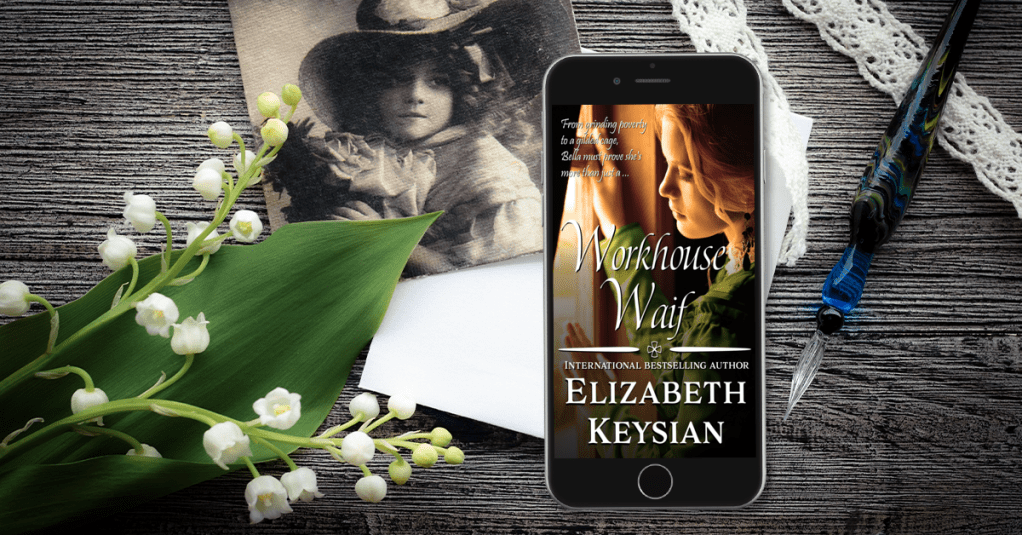
I’m reducing the price of Workhouse Waif to 99 cents/pence for a limited time.
So, why is Workhouse Waif so different to my usual books? Well, for a start, it’s set in the Victorian era. I also use a different style of writing in the book- it’s a complete rewrite of a book called “Summer Storm” which was originally submitted to Mills and Boon. They didn’t like mysecondary characters, and suggested there was no point in me doing an R&R (rewrite and resubmit). I decided to show ‘em! And did a complete rewrite. The book is a little like Jane Eyre in scope- it begins with the heroine’s childhood in the workhouse, her struggles there, and her final escape. Of course, there’s a romantic element too, but I don’t want to give too much away.
I have drawn heavily on my knowledge of the Victorian woollen cloth industry in England to add authenticity to the book. I used to work in a museum housed in a former woollen mill, and many of the exhibits were related to that industry. I found the subject fascinating.
Here is a link if you’d like to read the book. http://mybook.to/workhouse
Workhouse Waif can also be read for FREE with a Kindle Unlimited subscription. The story has had excellent reviews, and I hope it will garner a few more. Please let me know if you like it!
The cover is quite special too. Remember the awful bush fires in Australia? A group of writers, editors and cover artists got together and donated their services free to an online auction to raise money for the firefighters. I bid on the services of a cover designer, Matt Picinich, and won, so I now have a gorgeous cover that suits the book perfectly, even down to the green of the heroine’s dress. But you’ll have to read the book to discover the significance of that.
Here’s the link again for the discounted digital version of Workhouse Waif. http://mybook.to/workhouse Enjoy!
I should have mentioned this sooner but…
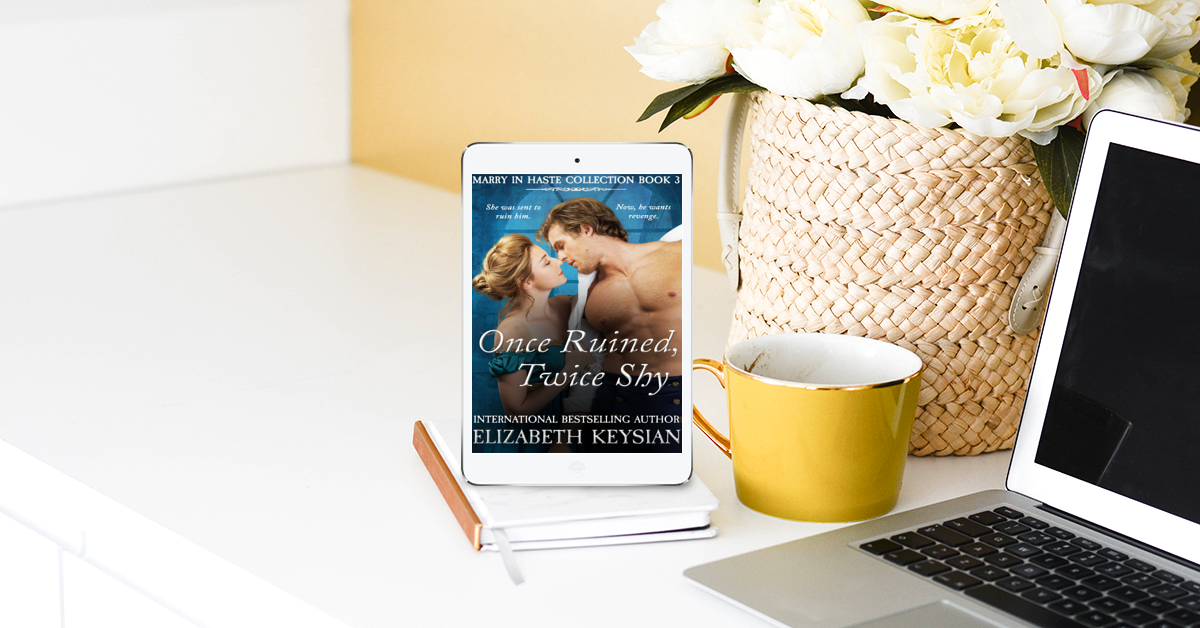
For the rest of today, Monday September 7th 2020, Regency romance, ONCE RUINED, TWICE SHY, is FREE to download on Amazon. You can get it HERE.
Here’s the story-
She was sent to ruin him. Now, he wants his revenge.
Miss Hestia Normanton hasn’t much further to fall. The man with whom she eloped refuses to marry her until she brings down his enemy, Conall Methuen, Earl of Corsbury.
Methuen, tortured by the untimely death of his fiancee, hides away from the world, injured and disfigured. Hestia’s arrival brightens his bitter existence, but interferes with his fundamental need to revenge himself on the man who stole the woman he loved.
Hestia’s lover Frederick, a man with a murky past, links both the living and the dead. Can Hestia stop Frederick and Conall destroying one another? And how can she avoid ruin all over again?
Too many books, too little time!
How do you choose which historical romance to read next? Look at books featured in Historical Treasures, that’s what!
https://preview.mailerlite.com/h0i3q8
And why not go one step better and sign up to Collette Cameron’s fabulous digest of the best books and bargains out there? https://www.subscribepage.com/historical-treasures
Meet your next favourite historical fiction author!
Here’s a fab set of authors writing historical fiction and romance, stories in which to lose yourself!
https://books.bookfunnel.com/fallintohistoricalfiction/q3y779ngb9


 Seduction, Scandal & Spies